
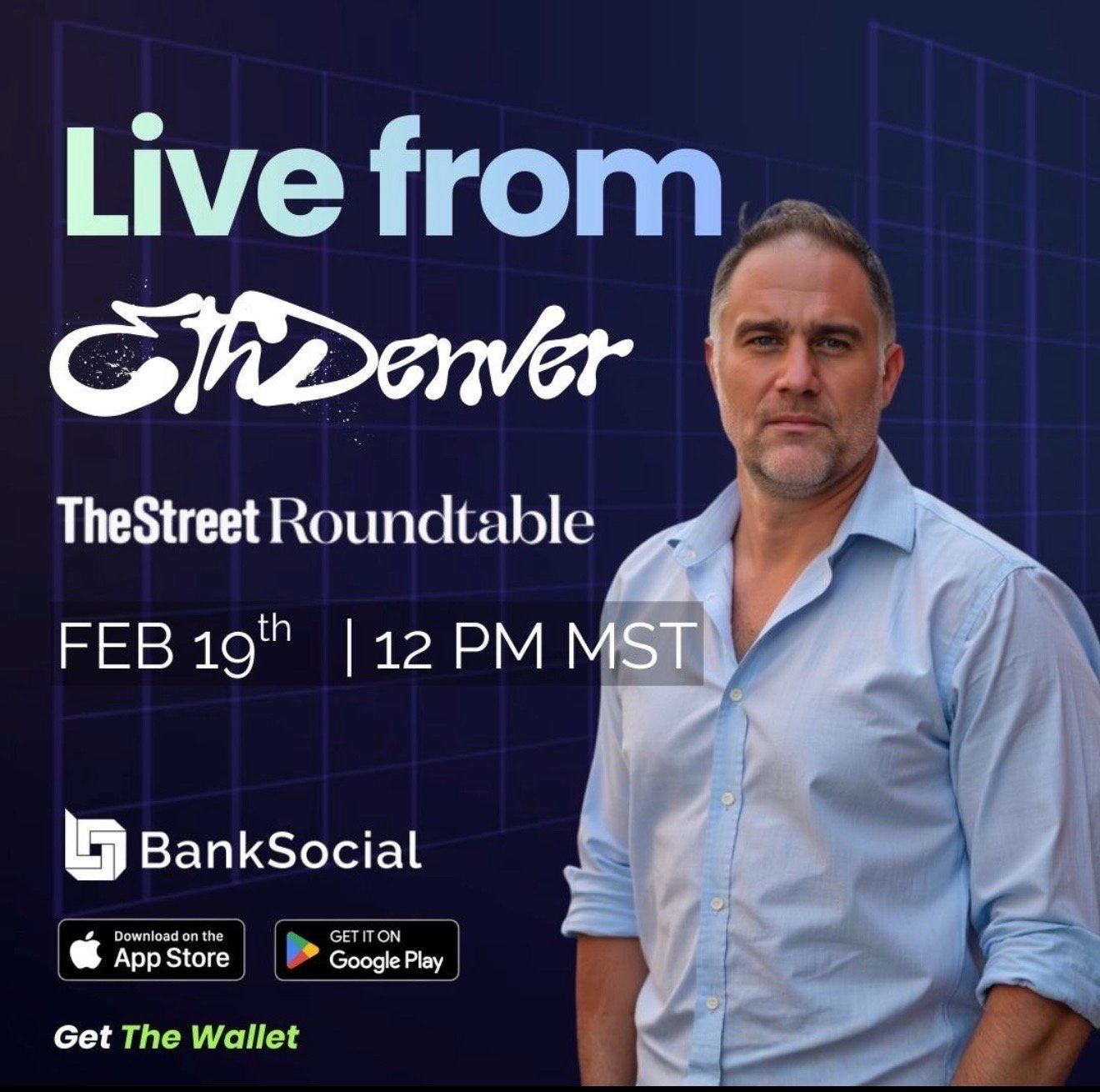
Through BankSocial, the fintech founder is working to give credit unions and community banks access to the real-time payments, digital assets, investing tools and artificial intelligence once reserved for the world’s largest financial institutions.
For decades, community banks and credit unions have occupied a distinctive position in American finance. They are often closer to their customers, more connected to their communities and more focused on long-term relationships than the largest financial institutions.Yet when it comes to technology, those advantages have frequently been undermined by a stubborn reality: smaller institutions rarely possess the budgets, engineering teams or infrastructure required to compete with global banks and venture-backed fintech companies.John Wingate believes that gap can be closed.As the founder, chairman and CEO of BankSocial, Wingate is building a financial technology platform designed to help community financial institutions deliver sophisticated digital services without replacing their entire technology stack. BankSocial’s platform brings together identity and onboarding, investing, payments and fraud protection in an integrated environment developed specifically for banks and credit unions. Wingate’s objective is larger than introducing another banking application. His vision is to give community institutions the infrastructure they need to participate in the future of finance rather than watch it develop around them.
Closing the Technology Divide
The modern financial customer expects money to move instantly. Consumers want seamless mobile onboarding, peer-to-peer transfers, digital investing, international payments and personalized experiences that work with the simplicity of the technology they use every day.Large banks can spend billions of dollars developing those capabilities. Community institutions generally cannot.BankSocial is attempting to change that equation by providing a unified layer through which institutions can introduce modern services more rapidly. Its Nuron platform is positioned as an AI-enabled command center that allows financial institutions to configure and manage payments, stocks, digital assets, fraud detection and customer experiences from one environment. The distinction is important. Rather than forcing a credit union to assemble numerous disconnected vendors, BankSocial is working to bring essential financial functions together while preserving the institution’s existing relationship with its members.Wingate’s philosophy is that community financial institutions should not have to surrender their customers to outside fintech platforms simply because those platforms moved faster.Banks and credit unions, in his view, should own the digital experience—not merely rent access to it.
Turning Real-Time Payments Into Reality
One of BankSocial’s most significant reported milestones arrived in November 2025, when the company announced that it had facilitated its first live instant payment using the Federal Reserve’s FedNow Service for a U.S. credit union client.According to BankSocial, the transaction was initiated inside the credit union’s digital banking experience and settled within seconds. The system incorporated identity verification, configurable institutional controls and fraud-prevention measures designed for regulated financial environments. The achievement illustrated Wingate’s broader strategy: innovation must be practical enough to operate inside real financial institutions.For Wingate, the future of payments is not defined merely by faster transactions. It is shaped by the intelligence surrounding those transactions—the identity of the participants, the context of the payment, institutional policy and the ability to detect risk in real time.He has described this evolution as a shift toward payments orchestration, where financial institutions coordinate multiple payment methods and decision-making tools through a unified infrastructure. That approach could allow community institutions to provide the speed consumers expect without abandoning the compliance, security and trust on which their reputations depend.
Moving Beyond the Crypto Narrative
Although BankSocial has roots in blockchain and digital assets, Wingate’s recent messaging has increasingly focused on functional financial infrastructure rather than speculation.In a February 2026 interview, he argued that institutional interest in digital assets is being driven by products with identifiable use cases and revenue models. Payments, stablecoins and tokenization are gaining attention not simply as emerging technologies, but as tools capable of improving how value moves through the financial system. BankSocial’s consumer wallet reflects part of that convergence. The platform combines self-custody of digital assets with cryptocurrency trading, stock investing and broader financial-management capabilities. Its institutional offerings are designed to let banks and credit unions provide similar services within environments their members already recognize and trust. In November 2025, BankSocial also announced that it had been recognized as an official Jack Henry plugin provider. The integration is intended to make BankSocial’s payment, investing, digital-asset and fraud-prevention capabilities more accessible to financial institutions operating within the Jack Henry ecosystem. Each development supports the same premise: advanced financial technology should become an institutional capability, not a reason for customers to leave their institution.
A Founder Who Thinks Like an Engineer
Wingate describes his leadership position as “CEO³”—representing the roles of chief executive officer, chief experience officer and chief engineering officer.It is an unconventional title, but it captures the way he approaches BankSocial. He is not solely focused on corporate strategy. He also emphasizes how the product feels to the customer and how the underlying technology is constructed.BankSocial’s official biography describes Wingate as a serial entrepreneur with experience spanning software, finance and digital assets. It also identifies him as the architect of what he calls “Cooperative Capitalism,” an approach centered on transparency, participation and distributing value more directly among the people using a financial ecosystem. That cooperative philosophy naturally aligns with credit unions, which are owned by their members rather than outside shareholders.Wingate appears to view this structure not as an outdated model, but as an ideal foundation for the next generation of financial services. Combining cooperative ownership with modern infrastructure could allow credit unions to remain community-centered while competing technologically with much larger organizations.
Using AI to Accelerate Financial Innovation
Artificial intelligence has also become central to BankSocial’s development strategy.Wingate has written about the company’s “Human-Powered AI” workflow, in which AI supports employees across ideation, design, project management, software development and quality assurance. The goal, he explains, is not to eliminate human expertise but to give teams a copilot throughout the product-development process. This matters in an industry where new financial products have historically taken months or years to implement. By shortening the path from concept to working prototype, BankSocial hopes to give smaller institutions a pace of innovation that more closely resembles a technology company.The company is also expanding into embedded digital wealth. In March 2026, BankSocial announced that Credit Union 1 had selected its Prospera platform to provide integrated investing capabilities as part of the institution’s broader member experience. The development points toward a future in which payments, investing, identity, fraud protection and digital assets are no longer treated as separate products. Instead, they become connected parts of a single financial relationship.
Building a Future Community Institutions Can Own
The long-term significance of BankSocial will depend on execution, institutional adoption and the company’s ability to navigate the demanding regulatory and security requirements of financial services.But Wingate’s central argument is difficult to ignore.Community institutions do not lack trust. They do not lack customer relationships. They do not lack an understanding of the people and businesses they serve.What they have often lacked is access to modern infrastructure.Through BankSocial, John Wingate is trying to provide it—creating a bridge between the cooperative traditions of community finance and a future built around real-time payments, intelligent systems, digital ownership and deeply integrated financial experiences.The institutions that succeed in the next era of finance may not necessarily be the largest. They may be the ones capable of combining advanced technology with something that cannot be replicated by software alone: trust.Wingate is betting that community banks and credit unions already possess that advantage.BankSocial is being built to ensure they possess the technology to match it.